A practice exam, solved by hand
Problem
A complete written exam, in two versions (A and B) that change the details of each question, solved on paper. Three questions:
- Restructuring an E-R schema (35%): a first draft links professor, textbook, subject and
degree programme with one four-way relationship
Insegnamento(teaching). Promote it to an entity and add relationships, cardinalities and external identifiers, for four sets of rules. - Normalizing scientific congresses (35%): find the functional dependencies and the key, draw the conceptual schema and decompose into BCNF.
- Normalizing shops and brands (30%): key, BCNF decomposition and conceptual schema.
1 · Restructuring the teaching relationship
Common rules: each teaching is about one subject, has one professor and is offered by one degree programme; each professor holds zero or more teachings. What changes:
| Who teaches a subject | Teachings of a subject in one programme | Textbook | |
|---|---|---|---|
| A1 | always the same professor | at most one | one per teaching, can differ |
| A2 | possibly different professors | several, numbered by channel | one per subject |
| B1 | possibly different professors | at most one | one per subject |
| B2 | possibly different professors | several, numbered by channel | one per teaching, can differ |
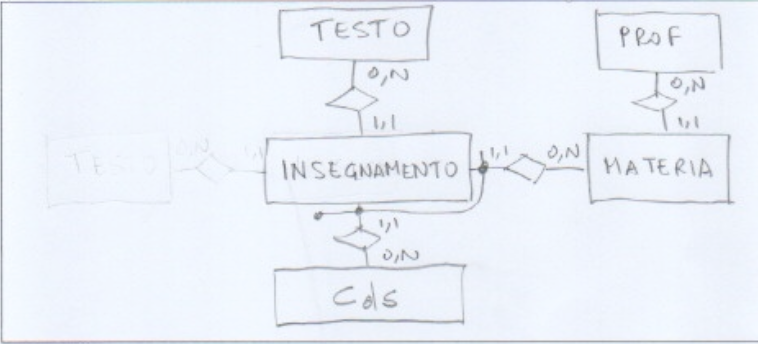
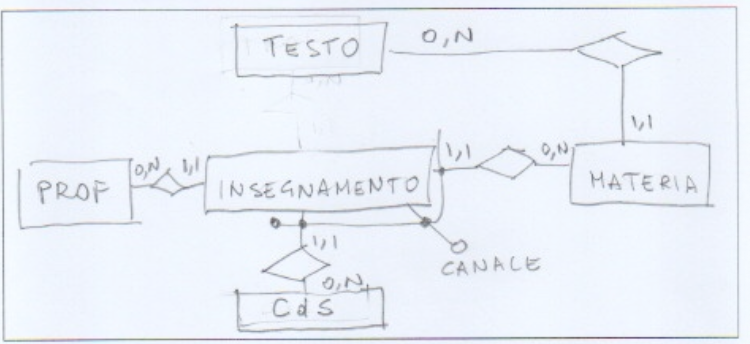
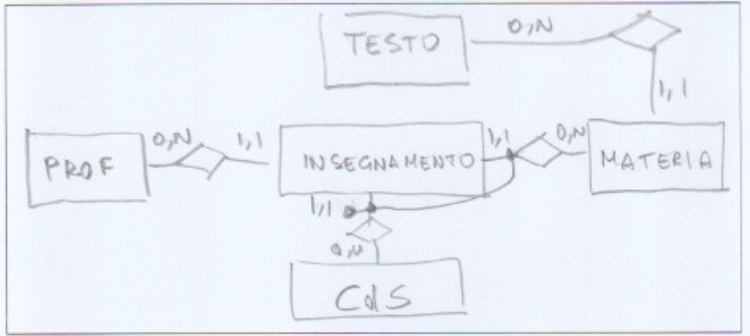
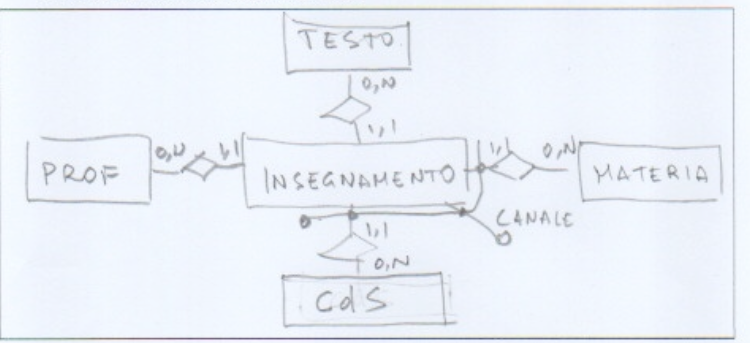
All four are correct, and each rule lands in the right place:
- the professor is linked to the subject when every teaching of a subject has the same professor (A1), to the teaching otherwise;
- the textbook is linked to the subject when all its teachings share it (A2, B1), to the teaching otherwise;
- the identifier of a teaching is external: subject + degree programme when there is at most one per programme (A1, B1), plus the channel when there can be several (A2, B2).
2 · Scientific congresses
A relation (Cod, Titolo, CC, Città, CN, Nazione, CM, Materia, CA, Area): each congress has a code
and a title and takes place in a city; cities have a code and a name and are in a nation; nations
have a code and a name; each congress is about a subject, which belongs to a scientific area; areas
have a code and a name. The two versions differ in which codes need context:
- A: the city code identifies a city; the subject code identifies it only within its area (M1 is ambiguous, the pair M1 A1 is not);
- B: the city code identifies a city only within its nation; the subject code identifies it.
Functional dependencies. Cod → Titolo, CC, CM, CA · CC → Città, CN · CN → Nazione · CM, CA → Materia · CA → Area. Key: Cod.
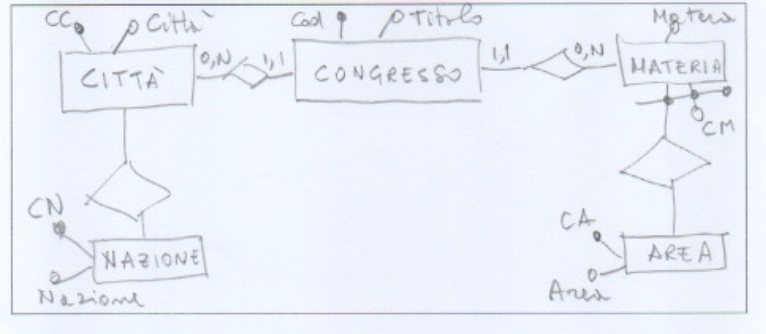
BCNF decomposition: (Cod, Titolo, CC, CM, CA) · (CC, Città, CN) · (CN, Nazione) · (CM, CA, Materia) · (CA, Area).
Functional dependencies. Cod → Titolo, CC, CN, CM · CC, CN → Città · CN → Nazione · CM → Materia, CA · CA → Area. Key: Cod.
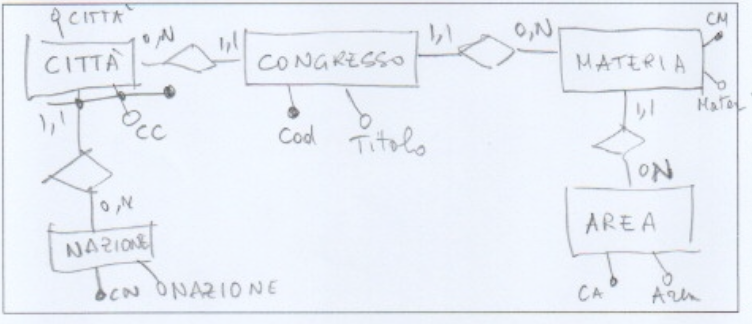
BCNF decomposition: (Cod, Titolo, CC, CN, CM) · (CC, CN, Città) · (CN, Nazione) · (CM, Materia, CA) · (CA, Area).
The difference between the versions is handled consistently in all three answers: the code that needs context gets a two-attribute left side in the dependencies, an external identifier in the E-R schema (the subject identified with its area in A, the city with its nation in B) and a two-column key in the decomposition. The congress does not link to the area directly: the area follows from the subject, and a direct link would be redundant.
Review note
In version A the relationships city–nation and subject–area have no cardinalities: (1,1) on the city and on the subject, (0,N) on the nation and on the area, as drawn in version B.
3 · Shops and brands
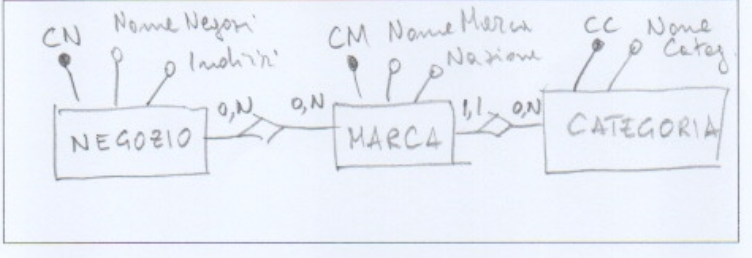
A relation (CN, NomeNegozio, Indirizzo, CM, NomeMarca, Nazione, CC, NomeCategoria) lists which
brands each shop sells, with the dependencies CN → NomeNegozio, Indirizzo · CM → NomeMarca,
Nazione, CC · CC → NomeCategoria. Version B adds the floor of the shop and drops the brand's
nation.
Key: (CN, CM). BCNF decomposition: (CN, NomeNegozio, Indirizzo) · (CM, NomeMarca, Nazione, CC) · (CC, NomeCategoria) · (CN, CM).
Key: (CN, CM). BCNF decomposition: (CN, NomeNegozio, Indirizzo, Piano) · (CM, NomeMarca, CC) · (CC, NomeCategoria) · (CN, CM).
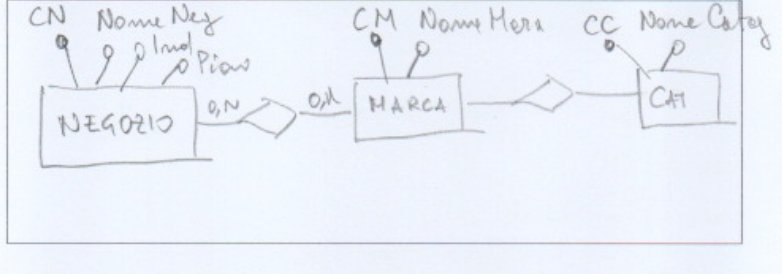
Correct in both versions. Neither CN nor CM alone determines the other, so the key is the pair; the table (CN, CM) that remains after extracting shops, brands and categories is exactly the many-to-many relationship between shop and brand in the E-R schema.
Review note
In version B the relationship between brand and category has no cardinalities: (1,1) on the brand, (0,N) on the category, as in version A.
Takeaways
- Where a rule says "always the same", the attribute or link moves up to the entity that fixes it (the professor and the textbook on the subject).
- A code that is unique only in a context shows up three times: as a composite left side, as an external identifier and as a composite key. Check that all three agree.
- After a BCNF decomposition, the table made only of keys is the many-to-many relationship of the conceptual schema.