Reverse engineering: from relational schema to E-R
Problem
The opposite of logical design: given a relational schema (tables, keys, referential constraints), draw a conceptual schema whose translation would produce it; in some questions, then extend that schema with new requirements. Four exams, five schemas.
Method
Read each table and ask what it was before translation:
| In the relational schema | In the E-R schema |
|---|---|
| a table with its own key and no foreign key in the key | an entity |
| a foreign key outside the key | a one-to-many relationship: (1,1) on the side of the table that holds it, (0,N) on the other |
| a key made only of foreign keys | a many-to-many relationship; the other columns are its attributes |
| a key made of a foreign key plus a local attribute | a weak entity, identified externally through the relationship |
Minimum cardinalities on the "many" side are (0,N) unless the schema forces something more: a relational schema cannot say that every theatre hosts at least one concert.
The diagrams are drawn with draw.io: dark ellipses are identifiers, light ones plain attributes; a line through a relationship ending in a dot marks an external identifier.
1 · Airlines and flights
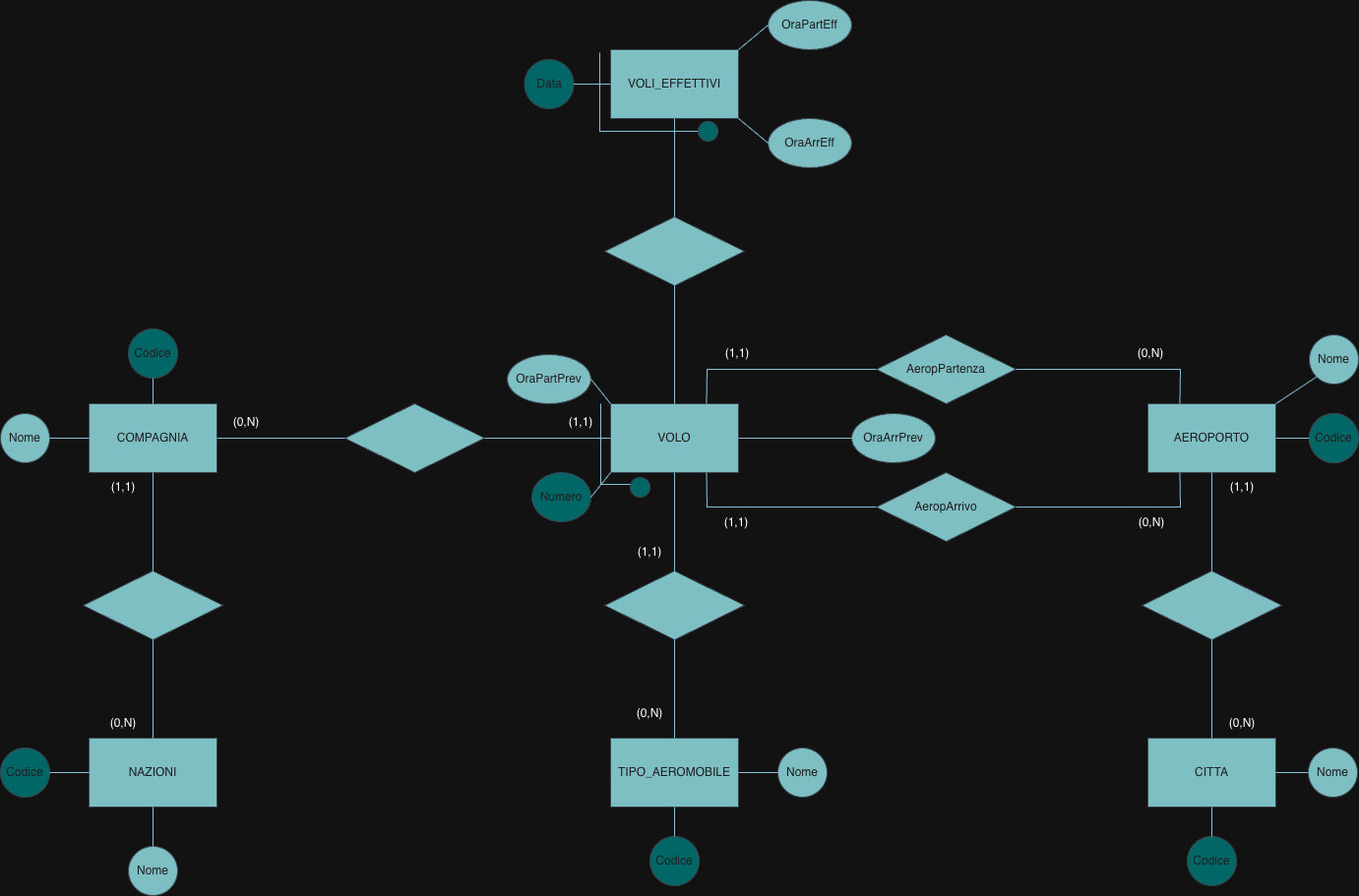
Schema. Nations; airlines (each of a nation); airports (each in a city); cities; flights, identified by airline and number, with departure and arrival airport, scheduled times and aircraft type; actual flights, identified by flight and date, with actual times; aircraft types.
Extension. Each flight runs on one or more days of the week, with possibly different times; individual aircraft matter, each with a code painted on the tail and a type; each actual flight is operated by one aircraft, which must be of the type of the flight; each city belongs to a nation. Also state any constraint the E-R model cannot express.
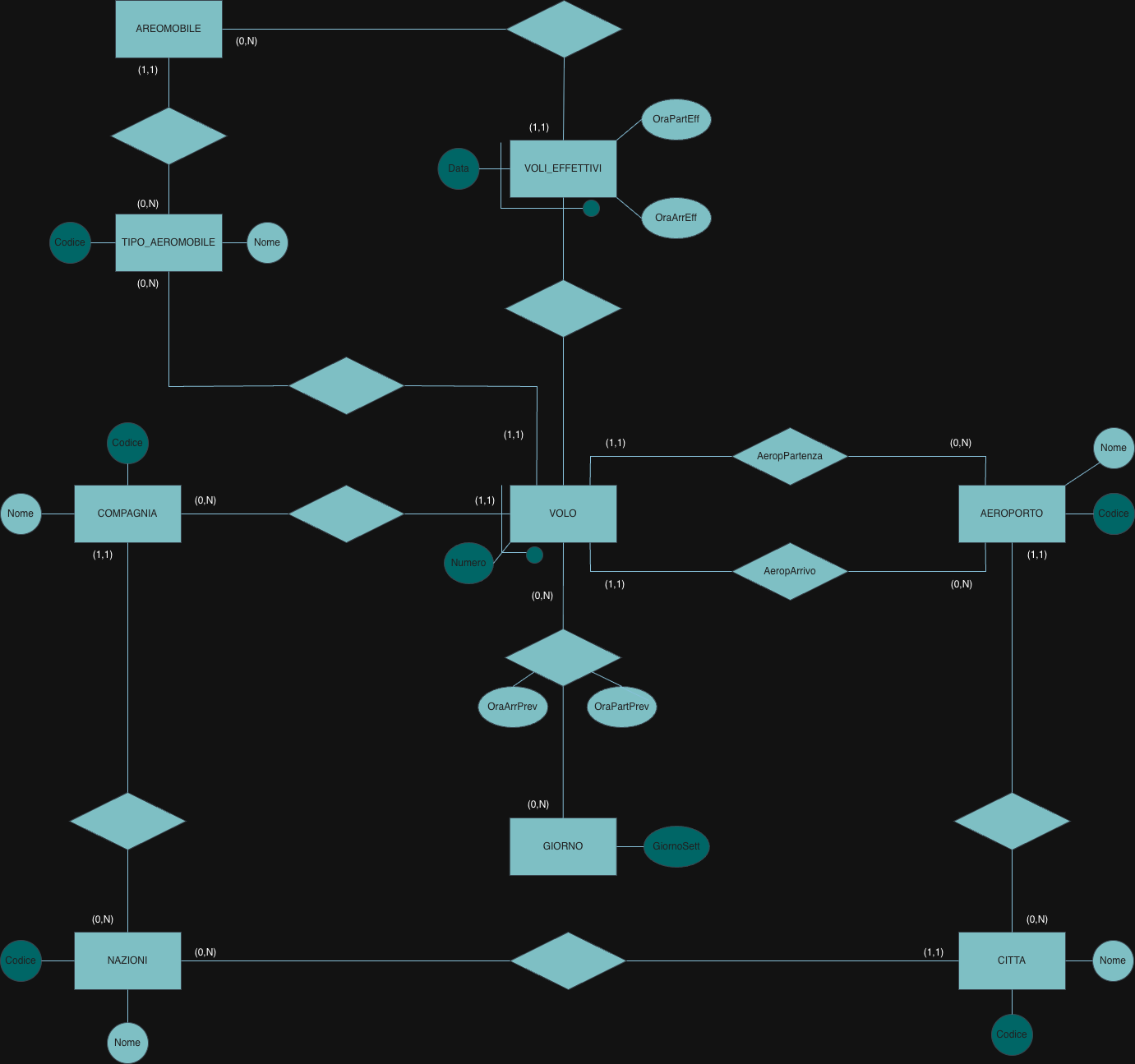
The scheduled times move from the flight to the relationship with GIORNO, because they can
change with the day.
Review notes
The translation is correct, with its two weak entities (VOLO, identified by airline and
number, and VOLI_EFFETTIVI, by flight and date). Points to complete:
- the relationship between
VOLOandVOLI_EFFETTIVIhas no cardinalities: (1,1) on the actual flight, (0,N) on the flight; - in the extension,
AEROMOBILE(spelledAREOMOBILE) has no attributes: the text gives it a code, which is its identifier; a flight runs on one or more days, so theVOLOside of the relationship withGIORNOis (1,N), not (0,N); - the constraint the question asks for is missing: the aircraft of an actual flight must be of the type associated with that flight. Two paths in the schema reach the aircraft type, and E-R cannot require them to agree.
2 · Athletes and disciplines
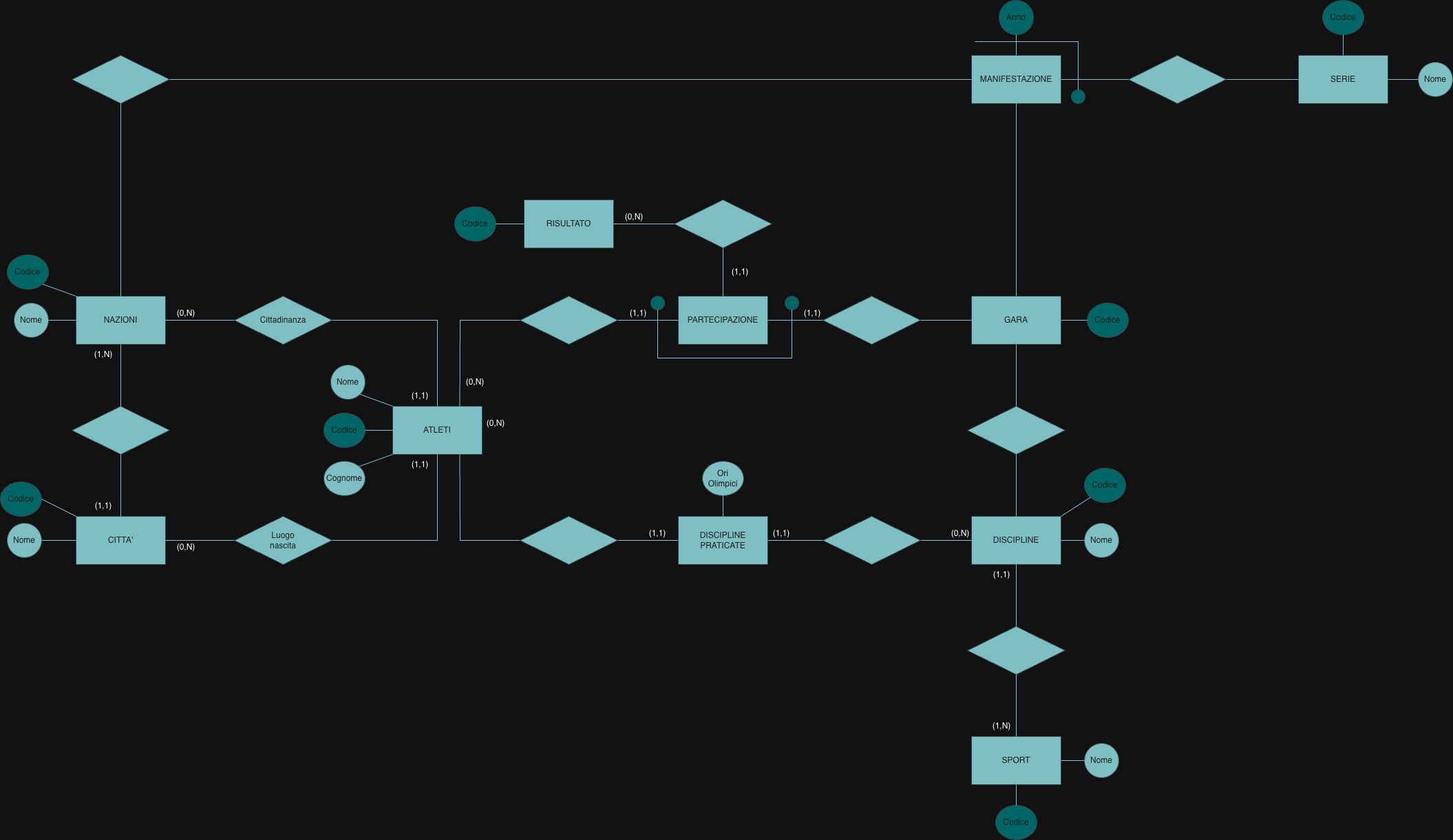
Schema. Nations; cities (each in a nation); athletes, with place of birth and citizenship; the disciplines each athlete practises, with the number of Olympic gold medals in that discipline; disciplines (each of a sport, for example the 100 metres in athletics); sports.
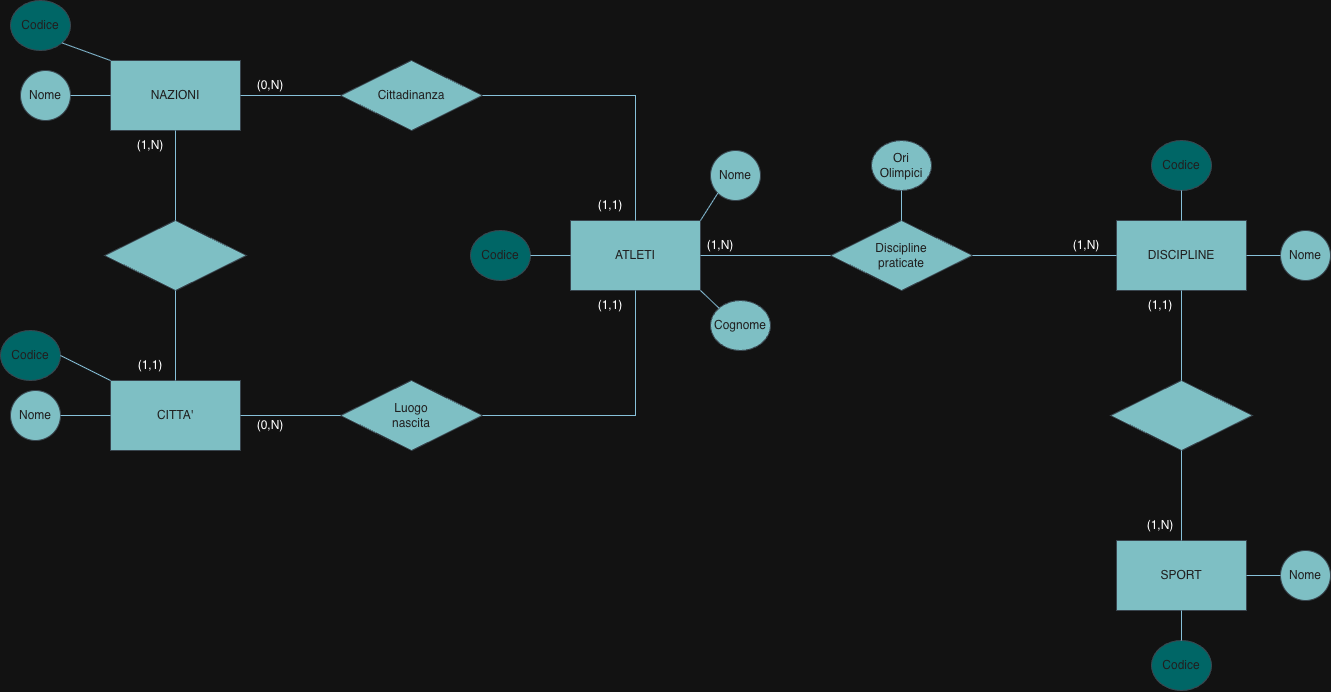
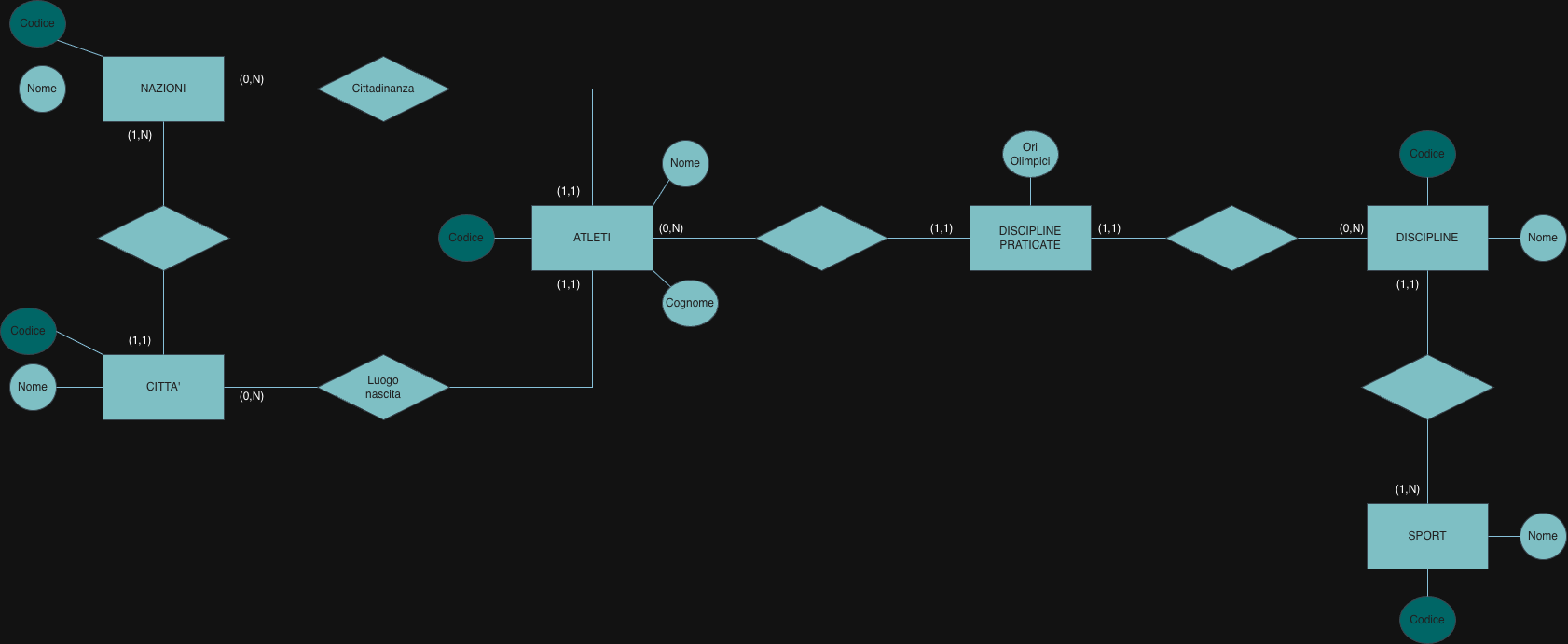
The table DisciplinePraticate(Atleta, Disciplina, OriOlimpici) has a key made only of foreign
keys: it is a many-to-many relationship with the attribute OriOlimpici. The first diagram
says exactly this.
Extension. The individual races an athlete took part in matter, with the result (from a list of predefined values, each with a code); each race belongs to an event (the 2024 Olympics), each event to a series (the Olympics); for each event, the nation and the year, which identifies it within the series; each series has a code and a name.
Review notes
PARTECIPAZIONE as an entity identified by athlete and race, with a link to RISULTATO,
and MANIFESTAZIONE identified by year and series are the right structures. To complete:
- in the second version of the base schema and in the extension,
DISCIPLINE PRATICATEis an entity without an identifier: likePARTECIPAZIONE, it should be identified externally by its two relationships, or kept as a relationship as in the first version; - the relationships of
GARAwithMANIFESTAZIONEandDISCIPLINE, and those ofMANIFESTAZIONEwithNAZIONIandSERIE, have no cardinalities; - the question also asks for constraints outside E-R, which are not written down: for example, that the discipline of a race is one of those practised by its participants.
3 · Tracks, concerts and theatres
Schema. Tracks (with the author as a string); concerts, each in a theatre; theatres; the programme of each concert (which track, in which position); events, identified by concert and date, with a time.
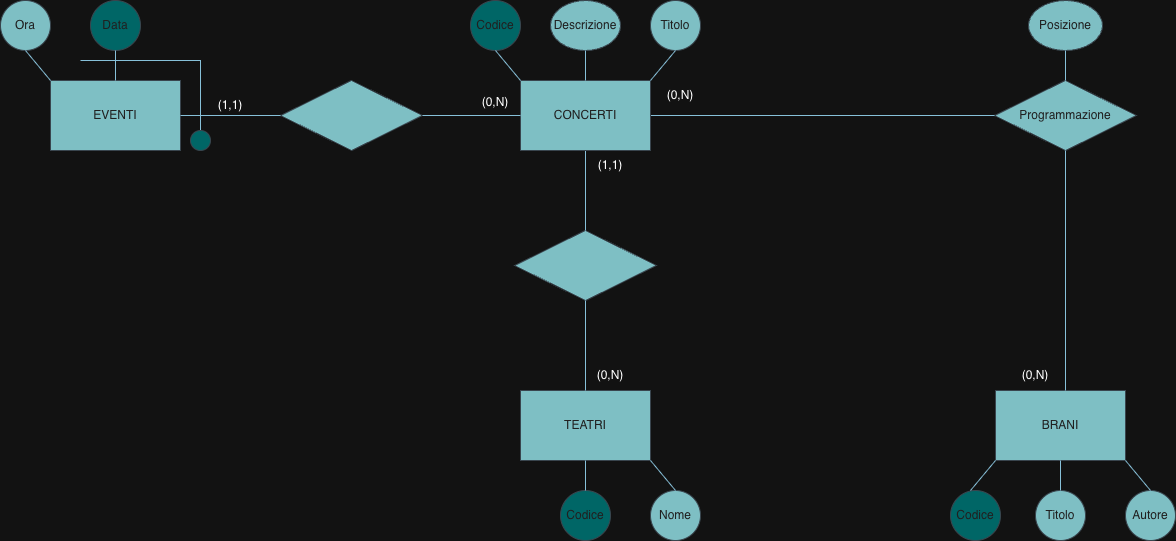
Extension. The events of a concert may now take place in different theatres, and a track may be repeated within a concert.
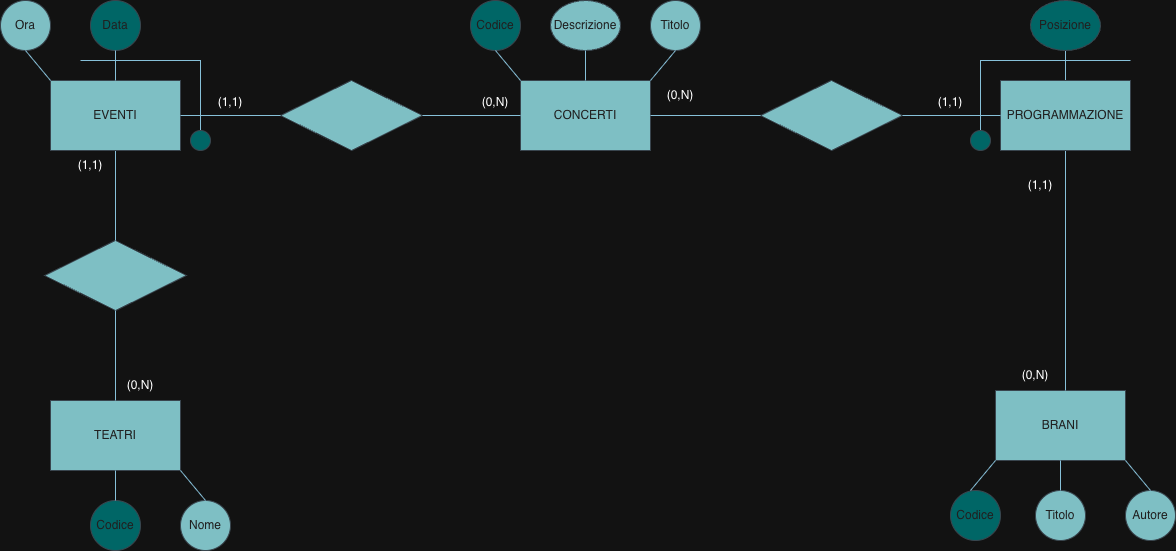
Logical schema of the extension:
- Teatri(Codice, Nome)
- Eventi(Data, Concerti, Ora, Teatro)
- Concerti(Codice, Descrizione, Titolo)
- Programmazione(Concerti, Posizione, Brani)
- Brani(Codice, Titolo, Autore)
The two changes are handled correctly: the theatre moves from the concert to the event; the
programme becomes an entity identified by concert and position, so the same track can
appear in two positions (the old key, concert and track, forbade it). The logical schema
follows; the referential constraints (Teatro, Concerti, Brani) are implied by the names
but not written.
4 · Concerts, orchestras and musicians
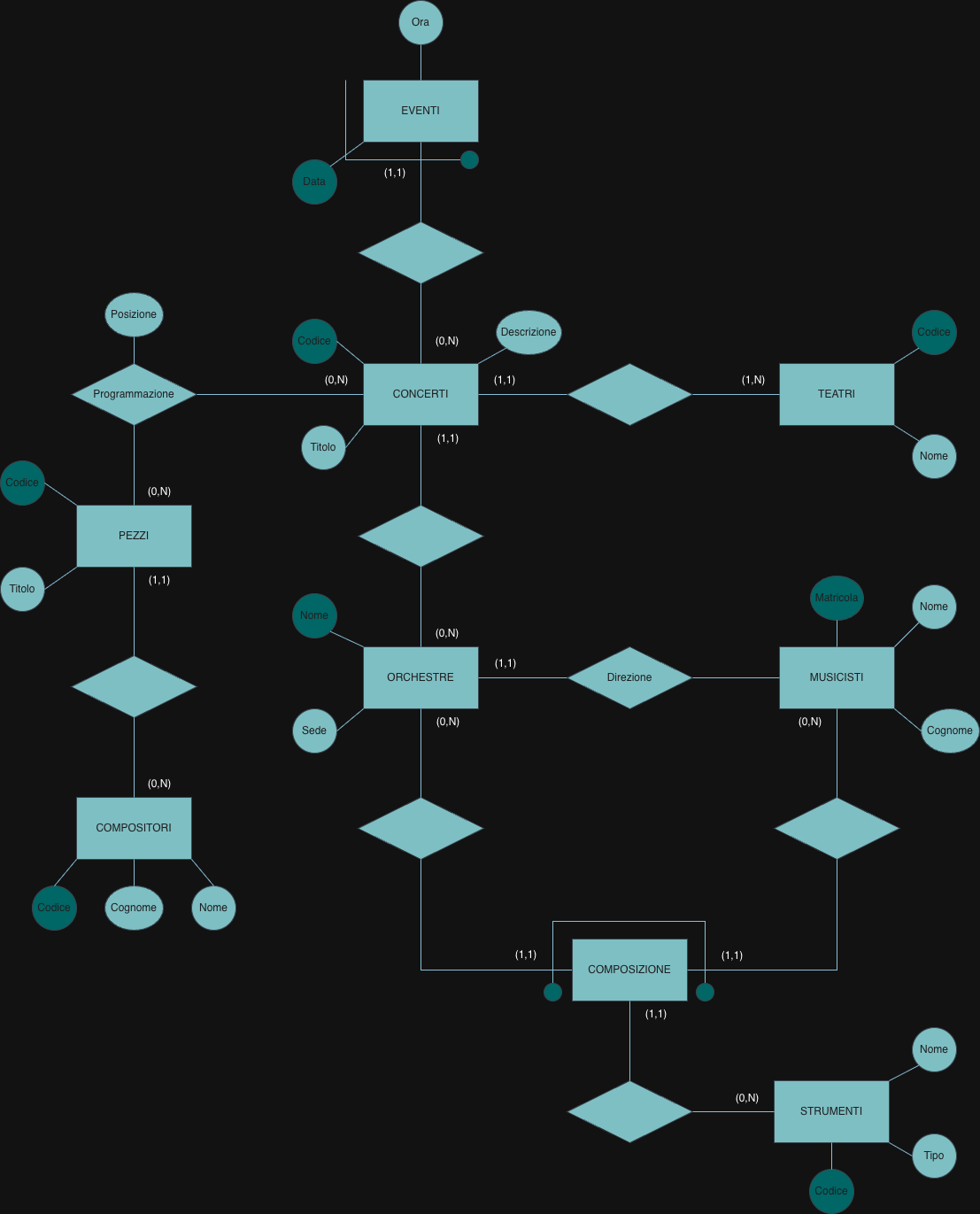
Schema. Pieces (each by a composer); composers; concerts, each with an orchestra and a theatre; theatres; programme; events; orchestras (identified by name, with a seat and a conductor who is a musician); musicians; the composition of each orchestra (which musician plays which instrument); instruments.
Review notes
Correct, including COMPOSIZIONE as an entity identified by musician and orchestra (a
musician plays one instrument in a given orchestra). Two cardinalities: a theatre does not
have to host a concert, so its side is (0,N), not (1,N); the musician side of Direzione
is missing, and is (0,N).
5 · Utilities and bills
Schema. Utility contracts, identified by area code and number, with holder and address; persons; districts (identified by area code, each in a province); provinces; bills (each for a contract); payments (each for a bill).
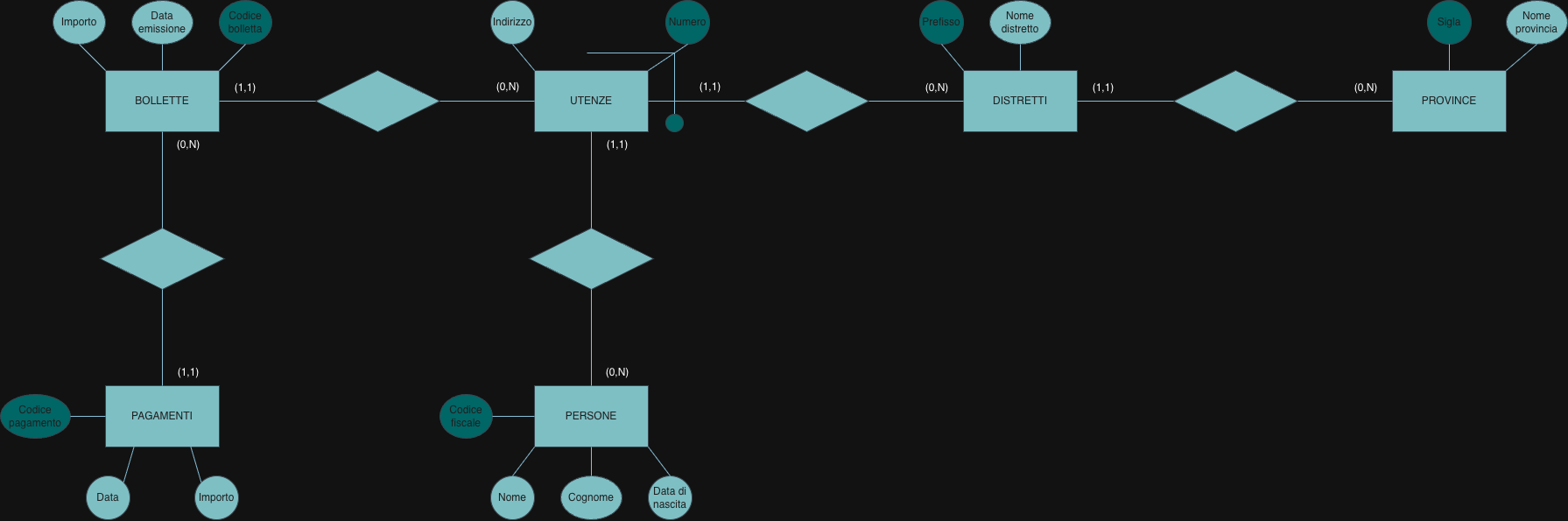
Correct: the contract is a weak entity identified by its number and its district, which is how the key (area code, number) arises; everything else is a chain of one-to-many relationships.
Takeaways
- The key of a table tells what it was: only foreign keys → relationship; foreign key plus a local attribute → weak entity; its own code → entity.
- When a requirement says "can be repeated", the old key is what forbids it: change the identifier (here, concert + position instead of concert + track).
- E-R cannot say that two paths through the schema must lead to the same occurrence: such constraints are written beside the diagram.